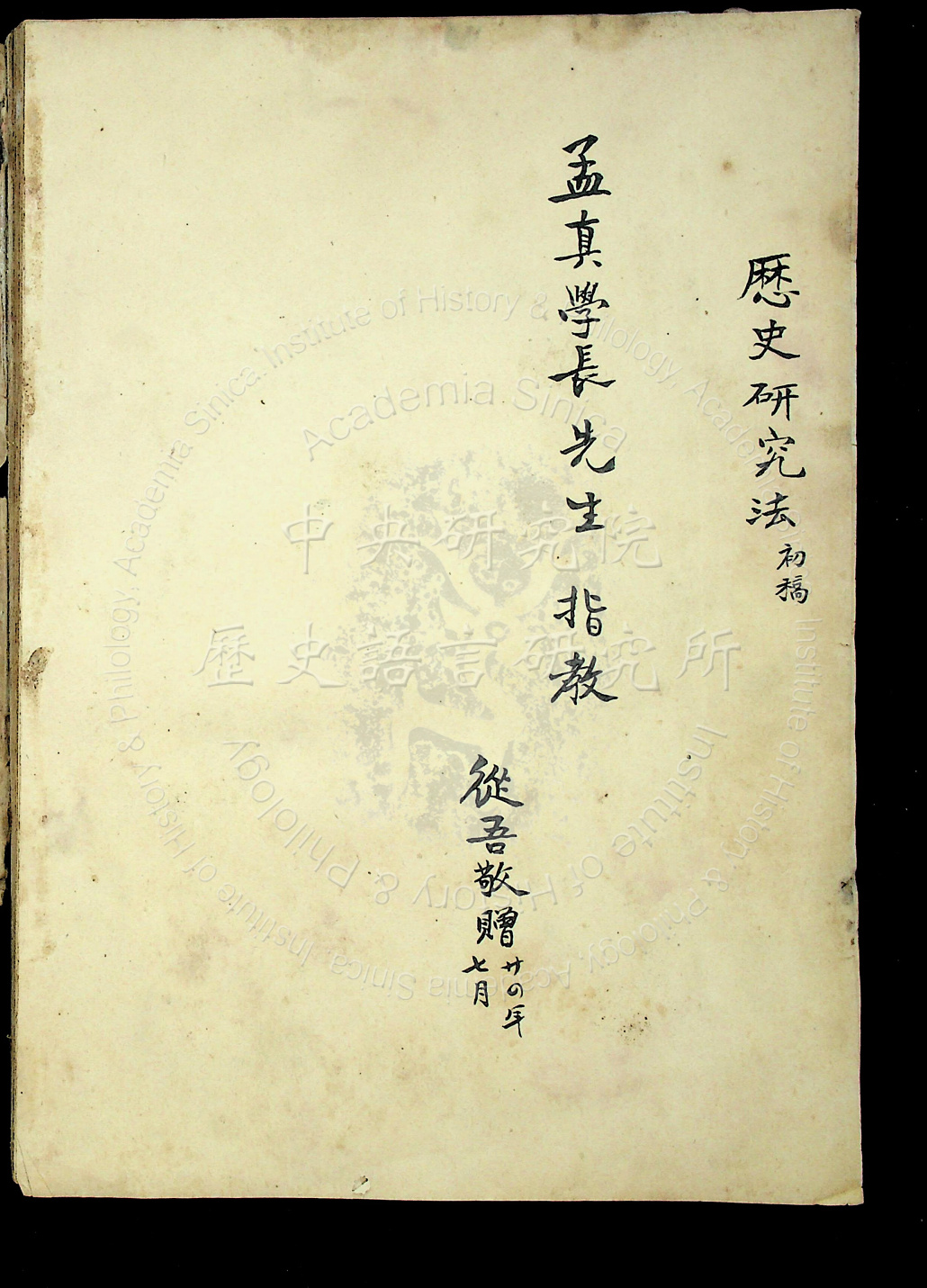
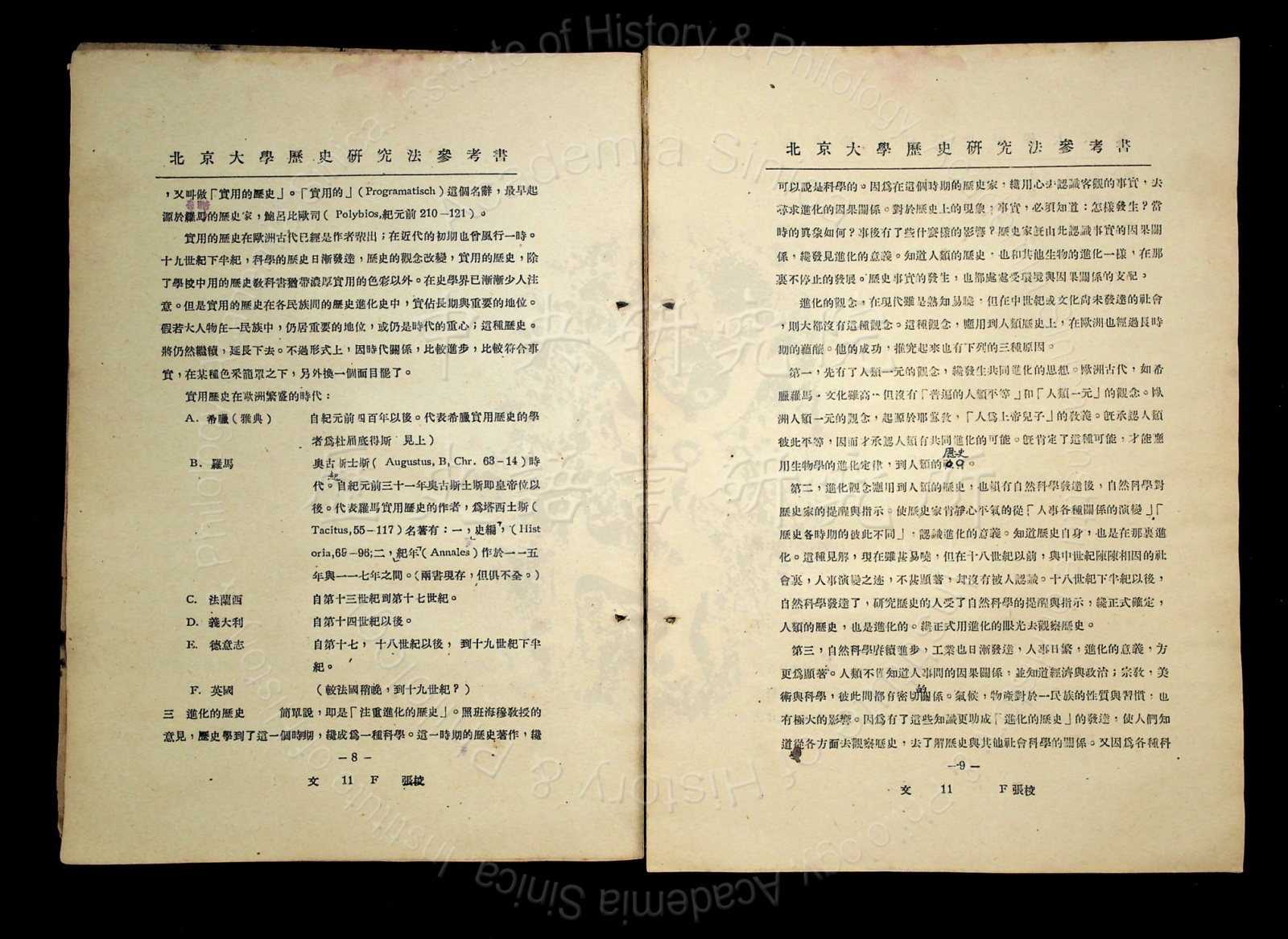
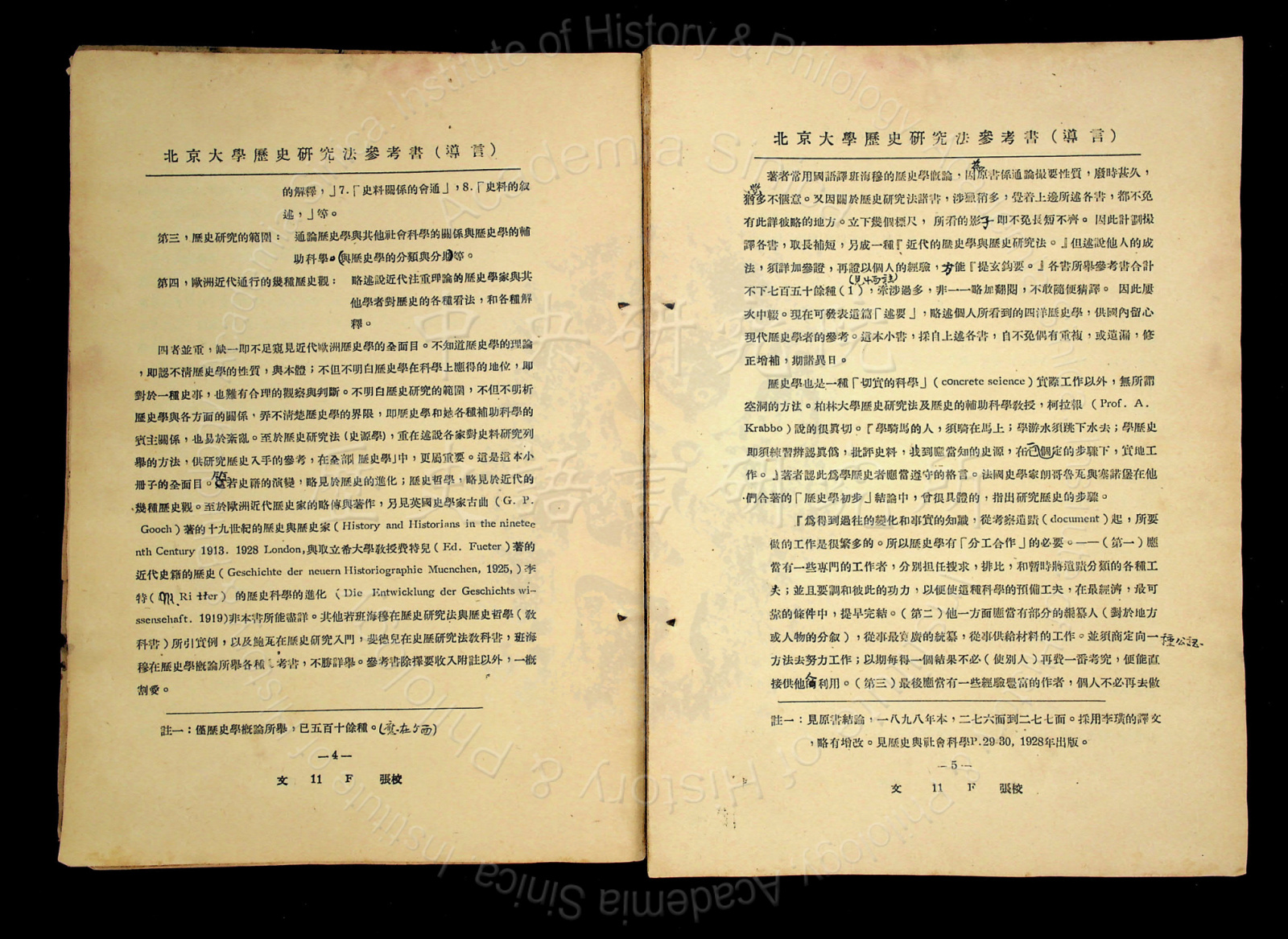
The Archives possesses a draft manuscript of Lishi yanjiufa (Historical Research Methods), compiled by Academician Ts’ung-wu Yao (1894–1970). The cover bears the inscription “Presented to [Fu Ssu-nien]; respectfully, [Yao], July 1935,” and each page has been stamped “Reference book for Historical Research Methods, Peking University” in the marginalia. Comprising four sections and totaling 198 pages, this work represents an early version of Yao’s unpublished lectures on historiography and thus serves as a crucial resource for examining how modern German historiography was introduced to China.
Ts’ung-wu Yao, a specialist in the history of the Liao, Jin, and Yuan dynasties, entered the IHP as a corresponding research fellow in 1955 and was later elected an academician in 1958. After studying Mongolian history in Germany beginning in 1923, Yao returned to China in 1934 to join the faculty of Peking University, where he established a course on historical methodology intended to introduce German empirical scholarship to Chinese academia. Following his relocation to Taiwan, Yao continued to teach the same course and cultivate the next generation of scholarship. Although his lectures had remained unpublished during his lifetime, his student, Professor Wei-yun Tu (1928–2012), compiled a version of Lishi fangfa lun (On Historical Methodology) in 1975, noting at the time that the early Peking University drafts were unavailable. In addition, Professor Xiaoqian Li (1977-) later published a version of Yao’s lectures held by the National Library of China in the edited volume Shixue yanjiufa weikan jiangyi si zhong (Four Unpublished Lectures on Historiography Research Methods) in 2015.
The Archives edition was presented to IHP Director Fu Ssu-nien (1896–1950), who was then teaching part-time at Peking University, in 1935. It is the version Yao wrote upon his return to China and is likely the Peking University lecture notes mentioned by Tu as no longer available. Numerous handwritten revisions are visible throughout the text. A comparison with the 2015 typeset edition confirms that the Archives edition predates the former. This text holds significant value for studying Yao’s conceptualization of and efforts in introducing historical research methods, as well as for understanding the formation of scholarly cultivation within modern historiography.
Ts’ung-wu Yao, a specialist in the history of the Liao, Jin, and Yuan dynasties, entered the IHP as a corresponding research fellow in 1955 and was later elected an academician in 1958. After studying Mongolian history in Germany beginning in 1923, Yao returned to China in 1934 to join the faculty of Peking University, where he established a course on historical methodology intended to introduce German empirical scholarship to Chinese academia. Following his relocation to Taiwan, Yao continued to teach the same course and cultivate the next generation of scholarship. Although his lectures had remained unpublished during his lifetime, his student, Professor Wei-yun Tu (1928–2012), compiled a version of Lishi fangfa lun (On Historical Methodology) in 1975, noting at the time that the early Peking University drafts were unavailable. In addition, Professor Xiaoqian Li (1977-) later published a version of Yao’s lectures held by the National Library of China in the edited volume Shixue yanjiufa weikan jiangyi si zhong (Four Unpublished Lectures on Historiography Research Methods) in 2015.
The Archives edition was presented to IHP Director Fu Ssu-nien (1896–1950), who was then teaching part-time at Peking University, in 1935. It is the version Yao wrote upon his return to China and is likely the Peking University lecture notes mentioned by Tu as no longer available. Numerous handwritten revisions are visible throughout the text. A comparison with the 2015 typeset edition confirms that the Archives edition predates the former. This text holds significant value for studying Yao’s conceptualization of and efforts in introducing historical research methods, as well as for understanding the formation of scholarly cultivation within modern historiography.