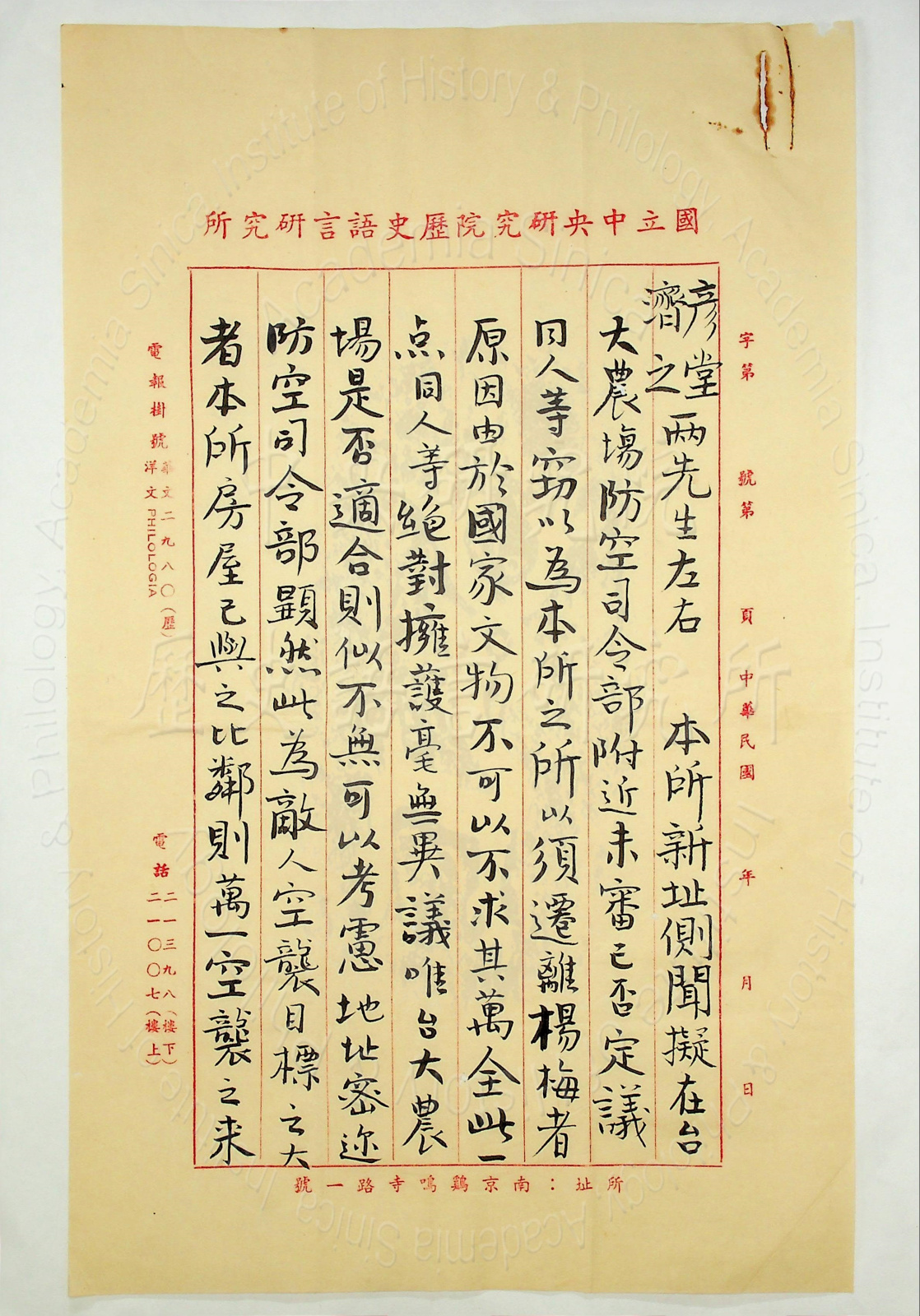
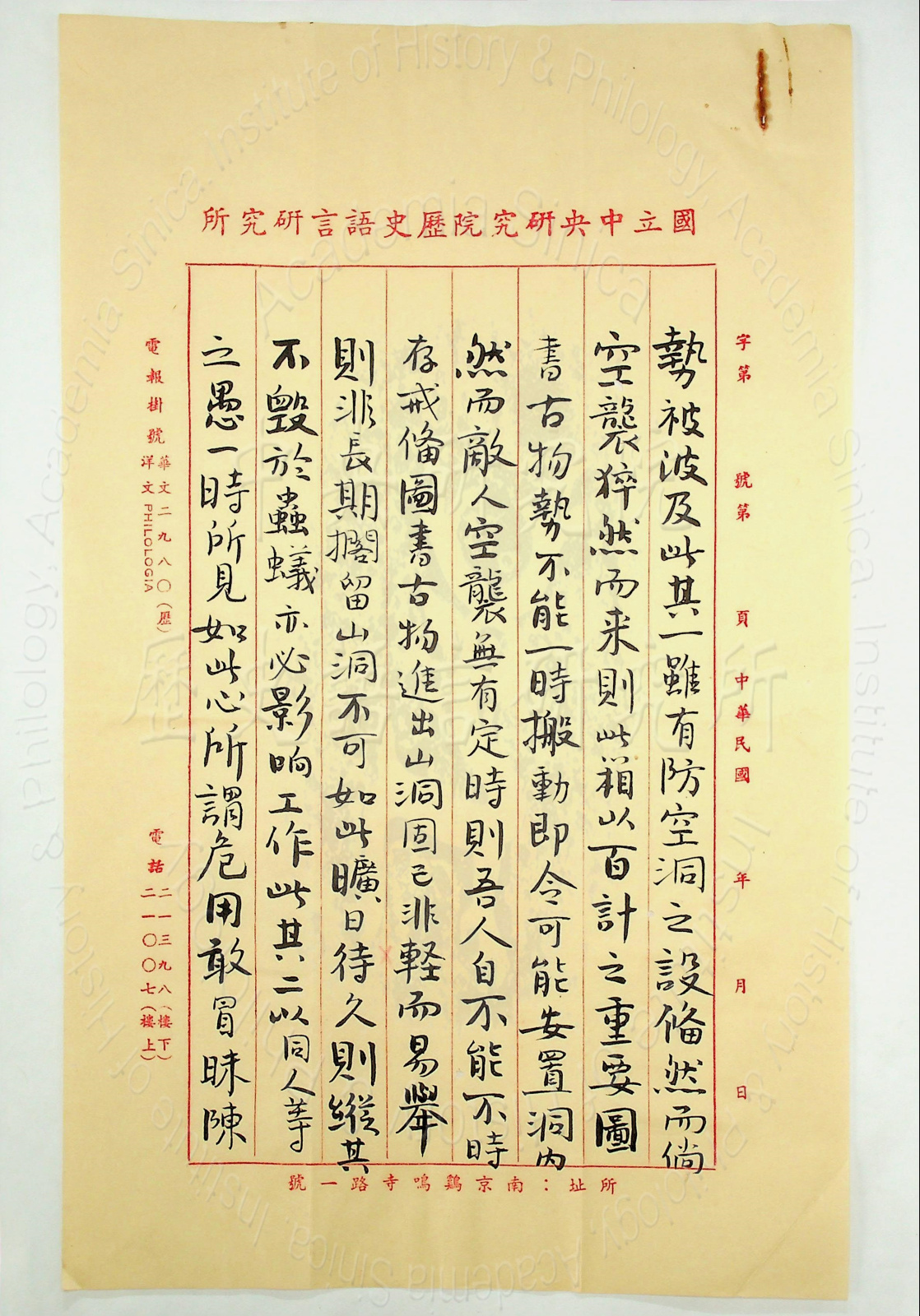
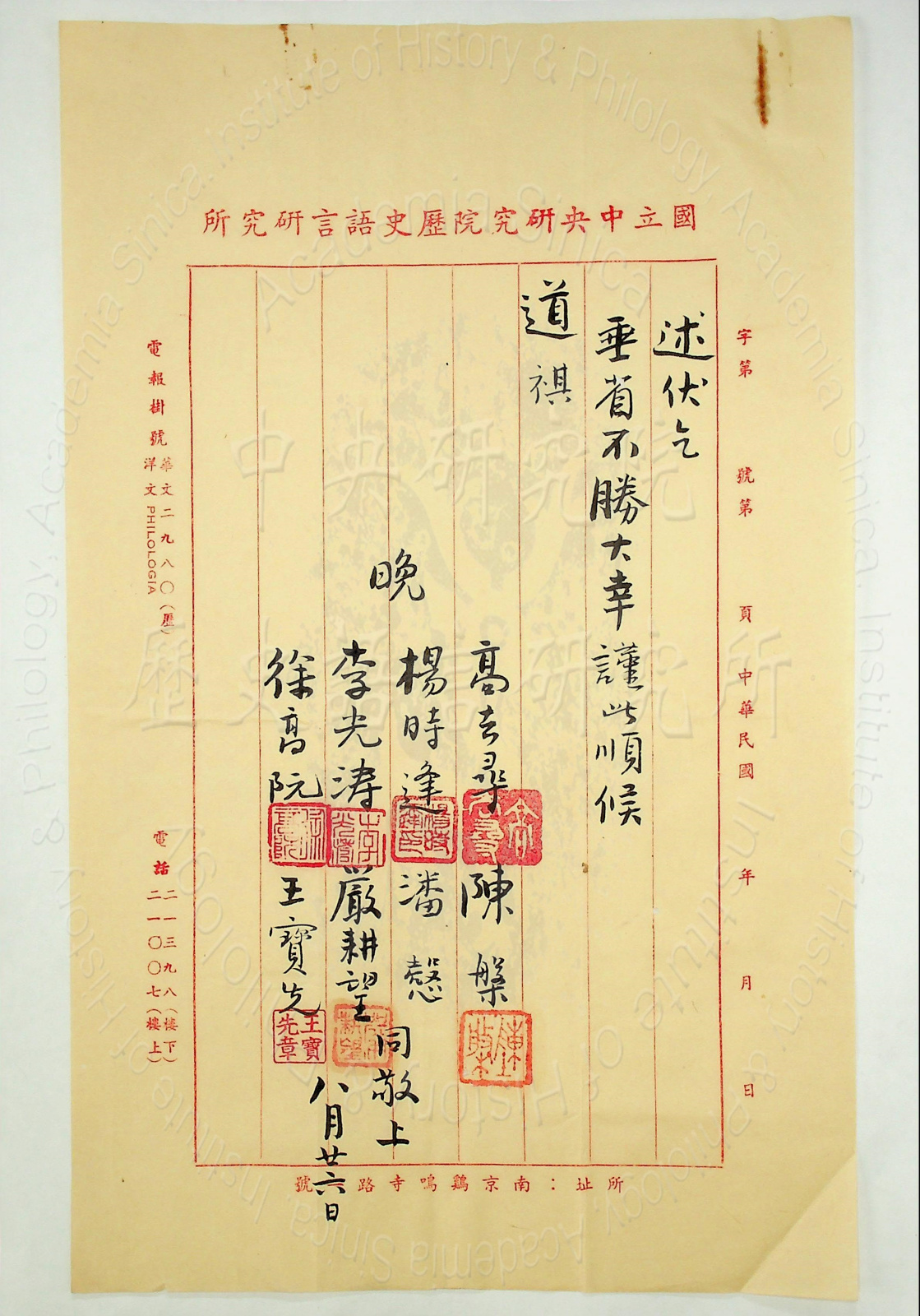
Following the relocation of the IHP to Taiwan in 1949, artifacts and other materials were temporarily housed in the storehouses of the Taiwan Railways Administration in Yangmei. Being along a major transportation route, however, the location was deemed vulnerable to bombing, especially in the 1950s when the situation in the Taiwan Strait grew increasingly tense. As a result, the IHP continually considered plans for further relocation.
According to the reminiscences of IHP Research Fellow Chang-ju Shih (1902–2004), a new site for the IHP needed to be both safe and reasonably close to Taipei. One proposed location was the experimental farm of National Taiwan University, which was located behind Dorm No. 6 near a hillside and was thus suitable for the construction of an air raid shelter and conveniently close to NTU. Yet, a letter preserved in the Archives, signed by several members of IHP research staff including Ch’u-hsun Kao (1910–1991) and Pan Chen (1905–1999) and sent to Tso-pin Tung (1895–1963) and Chi Li (1896–1979), expresses concerns that the site was too close to military facilities and therefore still susceptible to attack. Even with any bomb shelters, the transfer and preservation of rare books and artifacts would have posed a significant challenge. Perhaps for these reasons, the plan was ultimately abandoned.
For more on the above reminiscences, see Tsun-Kung Chen, Chung-yu Chen, and Yu-Te Jen, eds., Interview Record of Chang-ju Shih (Taipei: Institute of Modern History, Academia Sinica, 2022), pp. 324–325 (in Chinese).
According to the reminiscences of IHP Research Fellow Chang-ju Shih (1902–2004), a new site for the IHP needed to be both safe and reasonably close to Taipei. One proposed location was the experimental farm of National Taiwan University, which was located behind Dorm No. 6 near a hillside and was thus suitable for the construction of an air raid shelter and conveniently close to NTU. Yet, a letter preserved in the Archives, signed by several members of IHP research staff including Ch’u-hsun Kao (1910–1991) and Pan Chen (1905–1999) and sent to Tso-pin Tung (1895–1963) and Chi Li (1896–1979), expresses concerns that the site was too close to military facilities and therefore still susceptible to attack. Even with any bomb shelters, the transfer and preservation of rare books and artifacts would have posed a significant challenge. Perhaps for these reasons, the plan was ultimately abandoned.
For more on the above reminiscences, see Tsun-Kung Chen, Chung-yu Chen, and Yu-Te Jen, eds., Interview Record of Chang-ju Shih (Taipei: Institute of Modern History, Academia Sinica, 2022), pp. 324–325 (in Chinese).