From 1937 to 1938, amid the threat of war, IHP staff and equipment were relocated from Nanjing to Changsha, and shortly thereafter to Kunming, Yunnan province; in 1940, we were relocated once again to Lizhuang, Sichuan province. During our three years in Kunming, IHP fellows remained dedicated to academic research despite the turbulent times. Members of the Philology Section, including Shi-feng Yang (1903–1989), Sheng-shu Ting (1909–1989), and T’ung-ho Tung (1911–1963), took the opportunity to conduct comprehensive surveys of the Chinese dialects spoken in Yunnan. In 1969, drawing on these survey records, Yang published Yunnan fangyan diaocha baogao (Survey Report on Yunnan Dialects) in Taiwan, a monograph which details the phonetic recordings from more than 100 survey locations.
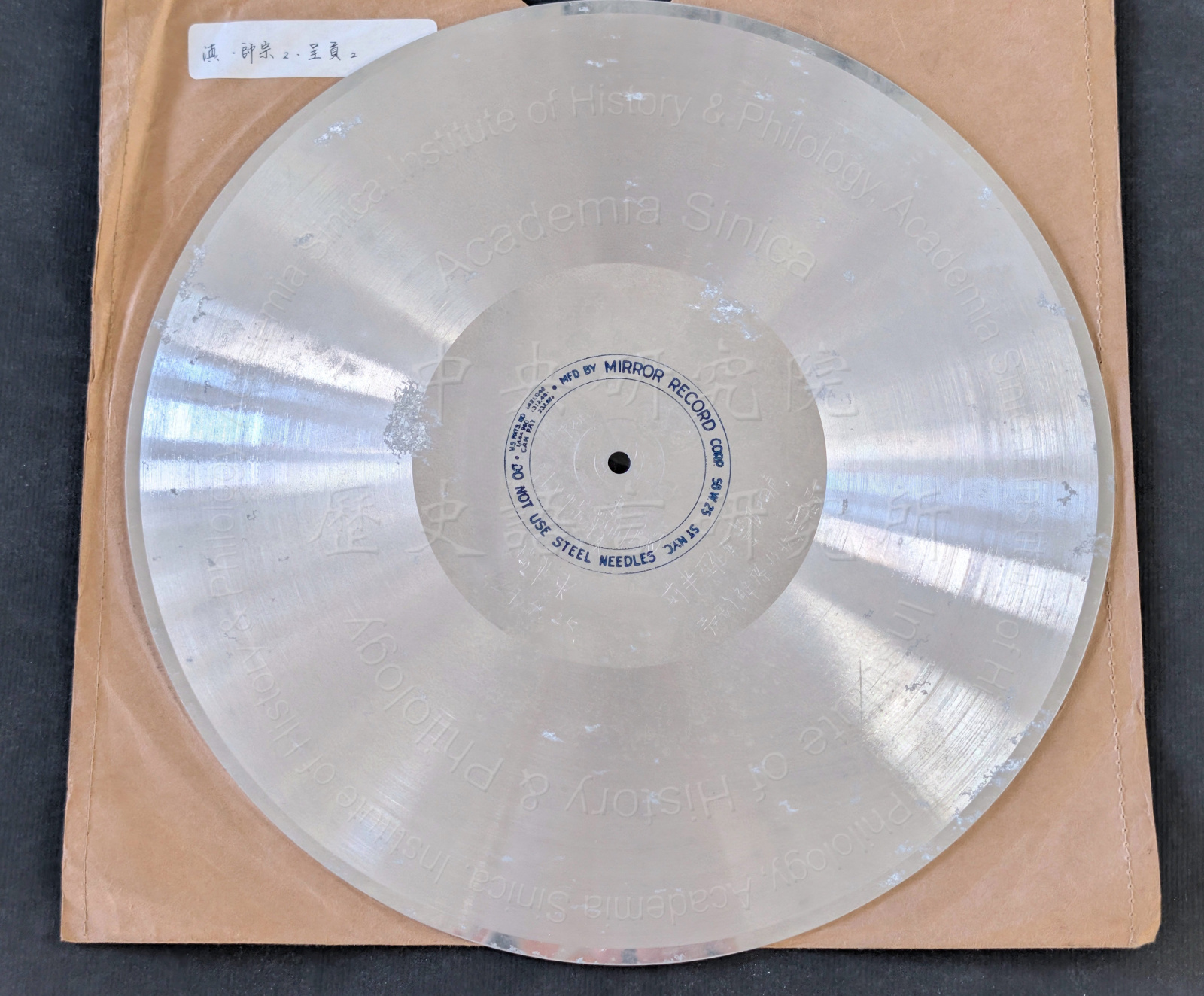
Among the aluminum discs held in the Archives, there are more than 190 containing recordings from Yunnan, most of which were captured during field surveys. To conserve materials and equipment, many discs contain audio from different regions on both sides, with an average of three sides recorded per survey location (1.5 discs). This differs from the account in Yang’s work, which states that four sides of a record were recorded at each location. Here the physical artifacts help to supplement the gaps in memory.
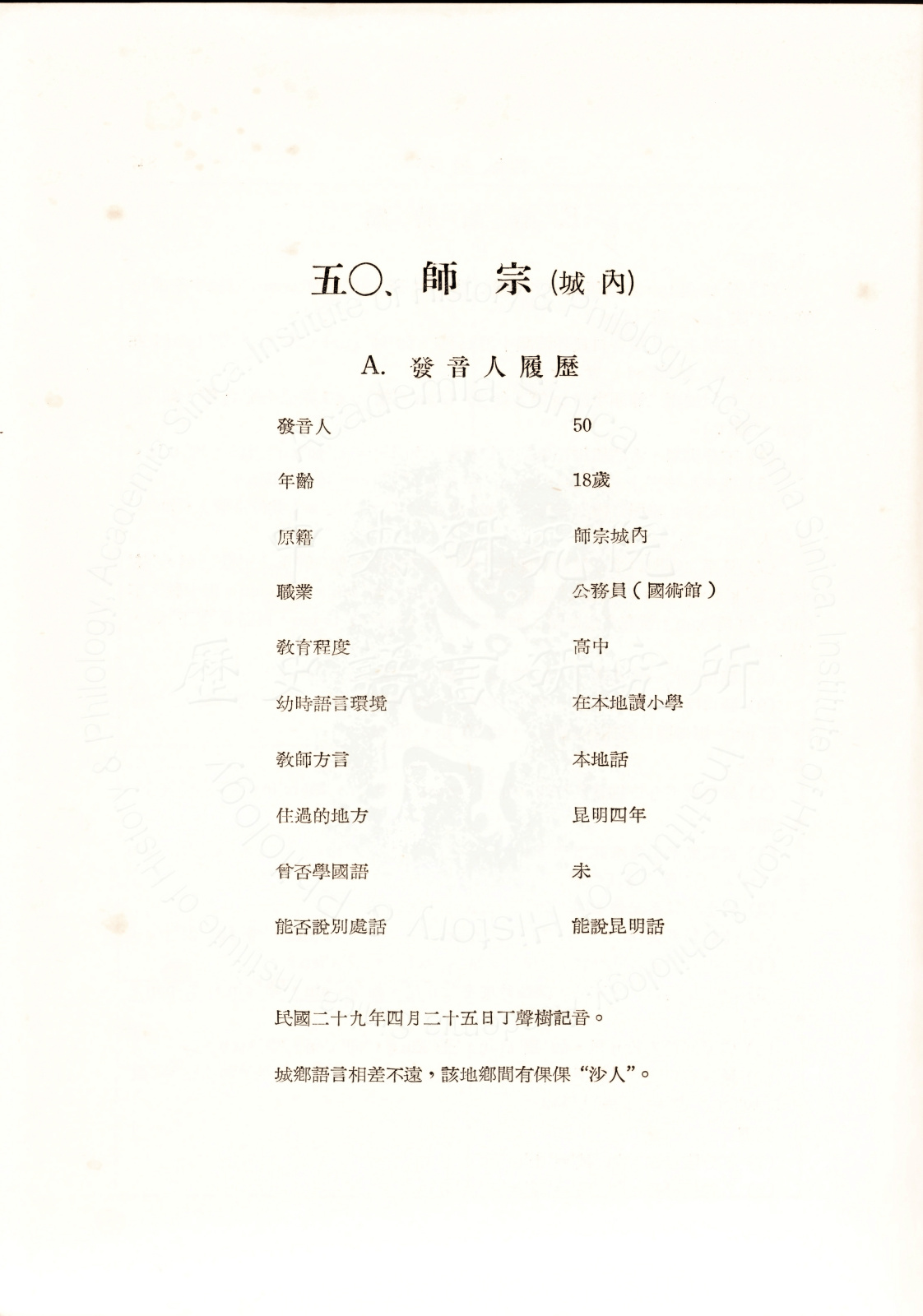
Shi-feng Yang’s work also mentions that many of these discs rusted when the IHP later relocated to Lizhuang due to the local humid environment, rendering them unplayable. Using modern technology, the Archives have been able to restore some of the recordings, one of which is a reading of “The Fox and the Tiger” folktale from the Shizong region, Yunnan.
This recording was produced on April 25, 1940. The speaker can be heard reading from a text, interspersed with the sounds of air-raid sirens. A review of Yunnan fangkong shilu (Yunnan Air Defense Records, 1945) confirms that on April 25, Japanese aircraft did indeed approach the Yunnan-Vietnam Highway on two occasions. Regulations of the time stipulate that a preliminary warning should first be issued when enemy aircraft approach within 300 kilometers, with an air-raid warning being issued at 250 kilometers. Records show that both warnings were issued in Kunming at 9:02 a.m. that day; another set of warnings was issued at 12:40 p.m. Shizong is located between the highway and Kunming, so the sirens captured in the recording were likely caused by these two Japanese air raids. The disc thus unexpectedly records IHP’s commitment to research even amid the looming shadow of war.